

Between the imagination sequences, it’s going to cut back to the interview room looking at the interviewer and his exprestion this is going to repeat for each imagination sequence. I am going to explain this in more detail in my next blog…
Between the imagination sequences, it’s going to cut back to the interview room looking at the interviewer and his exprestion this is going to repeat for each imagination sequence. I am going to explain this in more detail in my next blog…
The first 3 imagination sequences
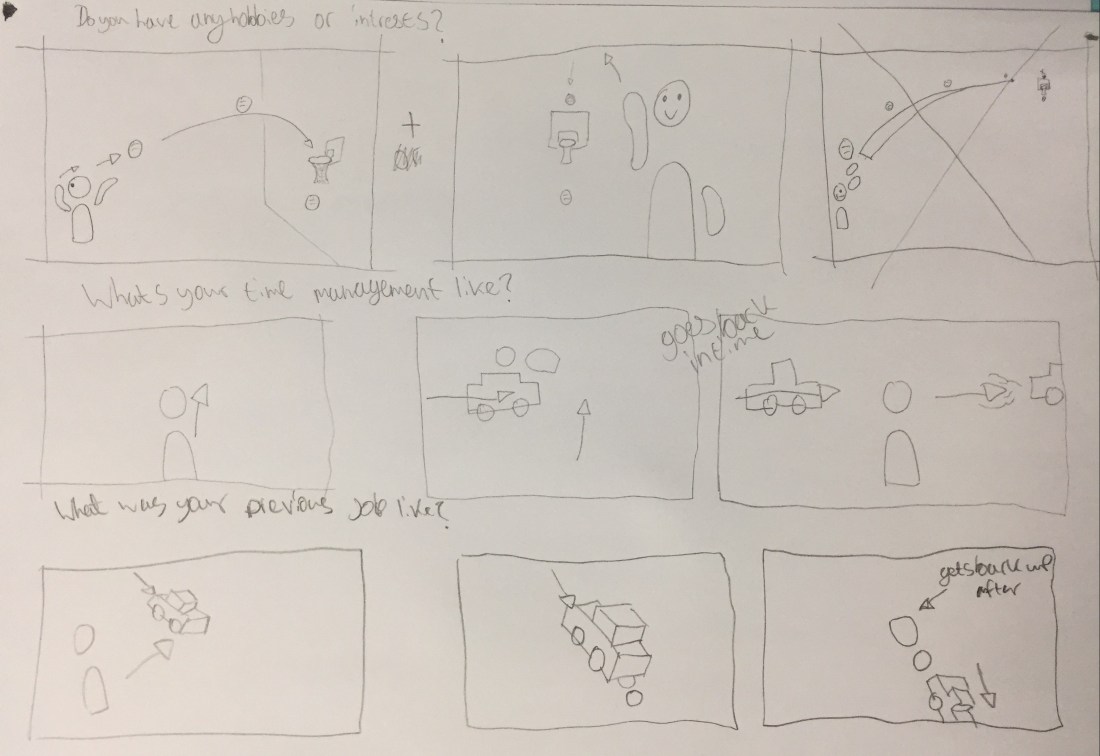
This is going off of my other audiance chosen effects. Just by when i asked them to answer a questionnaire and then i created a question to go with each effect. Know i have all my effect given story boards i can now start my storyboard for my interview scene.
This was because I created a storyboard with this consent so i decided to create a test shots seeing if i could create the effect.
Draft 1 \/
I had Vaseline and toilet role to create this effect I need more equipment.
Final Draft 2 \/
I had Sync-wax, makeup, thick fake blood and runny blood. With this extra equipment I was able to create a more realistic wound. I also did a little bit more tracking to create the sticky blood inside the wound, in after effects.
I had a little bit of practicing a while ago with wax, Vaseline and some fake blood. It didn’t look very good but i got an idea on how it works. Starting this project I only had Vaseline and toilet role (Draft 1) so i practiced a little bit with that and created my first draft. I then asked my teacher if they had any special effects makeup and they gave me a bunch of stuff. I only ended up using Sync-wax, makeup, thick fake blood and runny blood.
Firstly I started of by putting some clear tape n some green fabric and then sticking that on my hand. This is so i can key thins out to create the whole in my hand.
Secondly I took some wax and made a ring around the green fabric. Then i used some Vaseline to smooth out the outer sides of the ring so that it looks like i have a ring that is sunken inside my skin. I then just picket at the inner sides of the ring to make it flaky and look ripped.
Thirdly i added some more Vaseline around the outside and put some ripped toilet role around it to look like ripped skin. This part is hard because you need to blend he outsides to your skin and it will take some time.
Fourthly I then added the Thick fake blood round the inner area of the wound, trying not to get any on the middle area of the green fabric (its okay to get some on it round the out side but don’t get any in the middle). I then added a light layer around the outside and on the flaky of skin.
Finally, i then added detail like small craves-es where the skin has torn through and added more think blood there. I then took some make up and started making my skin look swollen. You can blend the blood with the mack up to get a bruised look. I also added some normal fake book and blended that in as well.
This was manly trial and error, I wanted to create this effect without looking at any tutorials because i wanted it to look and feel real. If i would have followed a tutorial i don’t think I would be able to use this in my short film as i need to used the green fabric to make the whole. However, i am going to use this effect on someone’s head for my final imagination sequence. I now need to create storyboards for the rest of my imagination sequences and then start on my interview storyboard.
I wanted to start my planning with this effect because in my Script Writing Blog i was told to plan the most interesting scenes first and then wrap a story behind it. So i did this where with my first imagination sequence.

I make a quick sketch and hear is a basic idea of what i would want one of my shots to look like once it is finished. The character gets shot and then the camera pans round looking through the head wound and then the guy drops to the floor.
I will test to see if i cant create this effect, as this is the imagination sequence with the most detail. I will do the same effect however instead of doing it on someones head do it on a hand instead, to make it easier to film.
I could do with creating my first text shot. Showing if i can actually create this effect with the materials i have.
The other effects i will be creating in my imagination sequences will be really easy to create i just need to look back at the tutorials i found and follow them. I will not go wrong when doing this as i am going to follow my key points from my editing techniques blog. I loke this effect that much i want it to get it right so I am going to do a test shot/run of the editing and filming so that i don’t make any mistakes when it comes to the actual gunshot effect.
Section 1: Wide shot of clock and office
Section 2: Interviewee whats into room and glances at clock
Section 3: Interviewee sits down and introduces himself
Section 4+5: Question and answer times 4
Section 6: Goes back in time and repeats the last 2 shots
Name Characteristics
Interviewer: Enthusiastic and exited to be in the interview.
Interviewee: Bored and lazy, wants the interview to be over quickly.
(attempts to shake hand, then sits down) Interviewee: (Enthusiastically) Hello again
(Clearly reading off sheet of paper) Interviewer: (mumbling) Hello and welcome to Rerun Accounting, I am going to ask you a few question about you and your passed roles. Ok?…
Interviewee: Sure, ill make sure to answer all questions as holistically as…
Interviewer: Yeah yeah whatever, trust me i don’t want to be here just as much as you do.
Interviewee: (Confused) Ok…
Interviewee: (Sigh) Right lets get started
Interviewer: (Slouches) Do you have any hobbies or interests?
Interviewee: (looks up) Well I really do enjoy my basket ball. It keeps me active and gets me outside, Id say i am quite skilled at it but… (Pause) yeah I’m alright.
Interviewer: Right ok… (confused look) What’s your time management like?
Interviewee: (Thinks about it and chuckles)
Interviewer: Whats so funny?!
Interviewee: Nothing, Nothing is. Its alright I suppose, erm… (Pause) i wouldn’t say its the best but I can get the job done. (Starts Laughing)
Interviewer: Why do you keep laughing? (confused look)
Interviewee: (Impassively) Never mind lets move on
Interviewer: (entreating, still slouched) What was your previous job like? Was it the Pizza delivery place down town?
Interviewee: (Confidently) Yeah it is, is was good, I really enjoyed it but it was quite boring because i was on my own a lot of the time (pause) there where always ways of making it interesting.
Interviewer: (sits up, confused and intrigued) Why did you get fired from your last job? I’m confused…
Interviewee: (looks down and vulnerable) I was on a normal delivery, it must have been an off day for me, and he was short on money. I wasn’t having any of it, so i… (Effects shows that he gets shot)
Interviewer: (Shocked exprestion)…
Interviewee: (annoyed) Right lets try this again… (pulls out phone and pushes button with other hand)
(attempts to shake hand, then sits down) Interviewee: (Enthusiastically) Hello again
(Clearly reading off sheet of paper) Interviewer: (mumbling) Hello and welcome to Rerun… (camera cuts to Interviewee, with a smug look on his face. Fades out)
I can know to start my planning. However, I do not need to do any research on storyboards, shot lists, Call sheets, production schedules, location shots, location recces and risk assessments as i have already done research of these in the past. I can now get into my most interesting imagination sequence which is the last question the gunshot effect.
Before i start creating my storyboards and shot lists i must look into camera techniques so that i can use these in my imagination sequences and or my interview segment.
This website shows multiple camera angle and shots that make films stand out from the rest.

Over-the-shoulder shots are just what the name says: a shot with an actor’s shoulder in the foreground, out of focus. I will tell you right away that good over-the-shoulder shots are some of the most time-consuming to shoot correctly because you need to make sure that there is neither too much nor too little shoulder in the frame. However, in my opinion, no serious filmmaker can afford not to learn this technique because it is narratively essential in many cases. Some directors openly say that they never shoot over-the-shoulder shots precisely because it takes ages to get the look they want and frequently can’t do it at all, but in my opinion, they are missing out. In my interview segment, this is going to be perfect for the back and forth between the interviewer and interviewee. Know i need to figure out what type of shots i need for my interviewee to walk into the office and greeting the interviewer.

Panning the shot is the horizontal equivalent of tilt shots. Like tilt shots, panning shots are conceptually simple and therefore usually overused and/or poorly executed. Exactly the same best-practice considerations made for the tilt shots apply to Panning shot: try and design them in such a way that you can lock off the tilt axis in order to keep the panning pure, and hire a competent camera operator, especially if your shots require precise timing and framing accuracy. Having a panning for my effects will work out great when i need a sturdy tripod shot. This is because i can create the panning in post-production so it looks like the shot was taken handheld and not takes from a still tripod shot.
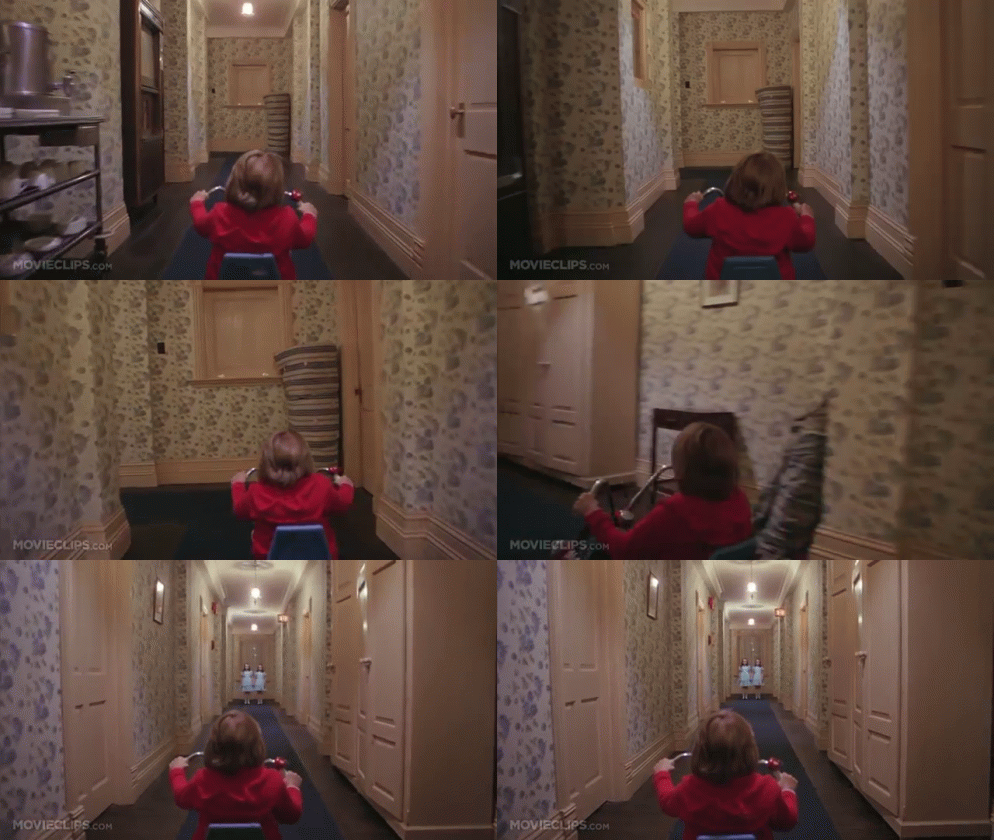
Setting up tracking shots is more complicated than setting up tilt or panning shots, but ultimately anyone can mount the camera on a dolly and moved the dolly along tracks. You must make it more interesting like bringing the track top a hold like in this shot above. This is the perfect kind of shot for my interviewee walking down the corridor and into the office room as it follows my actor and my audience can feel like they are going into the interview with him. I can also have this shot for most of my imagination sequences as i need the sequences to start off with my actor walking into the effect.
![[add-text output image]](https://im.ezgif.com/tmp/ezgif-1-7e05bf45d10b.gif)
Looking back on my panning shot I realised it would be a good idea to create a panning shot that is out of focus when starting off, then in focus when it hits my actor (as shown in my gif above). Having this shot as my actor just about walks into the interview room i can have this shot go into focus on the interviewers face. This will give the effect that the interviewee has noticed the interviewer and is nervous to have the interview with him. This will also make my audience feel nervous as if all these shots are placed together whatever the interviewee is feeling my audience will feel the same.
I can now start my script with all the research i have gathered throughout my blogs. That is because i need a script to then start my storyboards and then start to properly get into my planning.
South Paw has some Visual effects that you cant see that makes the movies stand out. I should have the same idea when creating my imagination sequences. FXguide made a blog all about Zero VFX work and how they created there VFX.
In the opening scene where you can see the outside of the stadium. The sign outside is blown up and made the building look more modern. This gave me the idea of changing the background, of some of my scenes. Such as making the houses in the background look smaller or taking them out completely and putting in some trees to make it look like the country side. Also changing the sky to a brighter blue if the day we fined at is dull and gray.
They also added blood spraying out of the boxers mouth as he gets punched. This is a great idea for when i get one of my characters to shoot the other one, i can add blood around the wound or have it come out of the whole in his head. This has just given me the idea from Shaun Of The Dead where the zombie has whole in its stomach. I could use the same effect with a bullet hole.
This is such a good scene that has some amazing visual effects. The zombie gets its stomach ripped out and you can see Shauns face through the whole. I this i can do this when my character gets shot in the head, i can have the other character face through the whole like in Shaun Of the Dead. I wont be hard to recreate it will just be time consuming. I will have to look at some tutorials and re jog my memory on how to key out a good green screen.
Also i was thinking about using fake blood and clay to create the effect on the acters face and then simple masking the SFX out in after effects they show you how to do this in the Film riot tutorial
Also I was thinking about using fake blood and clay to create the effect on the actors face and then simple masking the SFX out in after effects they show you how to do this in the Film riot tutorial.
Combining these effects with the Losses effects that i researched a while back i will definitely be able to pull of a decent effect. The tutorial i have linked above is the one i will be following however i need to create a bigger whole. I will do this but creating a larger ring on the actors head and putting some green tape or paper underneath and have the ring around it. Then i can simply take the blank shot and put that behind the actor clip. Key out the green and then add my blood insides. I am going to have to independently figure out how i can make the inside of him look real.
With this in mind before I start my first storyboard of this bullet whole effort. I must look at camera techniques because i want my shots to stand out and make the feeling that i want in the scene. I can also take a look at camera angle, not just for my imagination sequences, but for my interview aswell.
”Semiotics, also called semiology, the study of signs and sign-using behaviour. It was defined by one of its founders, the Swiss linguist Ferdinand de Saussure, as the study of “the life of signs within society.” Although the word was used in this sense in the 17th century by the English philosopher John Locke, the idea of semiotics as an interdisciplinary mode for examining phenomena in different fields emerged only in the late 19th and early 20th centuries with the independent work of Saussure and of the American philosopher Charles Sanders Peirce.”
Peirce’s seminal work in the field was anchored in pragmatism and logic. He defined a sign as “something which stands to somebody for something,” and one of his major contributions to semiotics was the categorization of signs into three main types: an icon, which resembles its referent (such as a road sign for falling rocks); an index, which is associated with its referent (as smoke is a sign of fire); and a symbol, which is related to its referent only by convention (as with words or traffic signals). Peirce also demonstrated that a sign can never have a definite meaning, for the meaning must be continuously qualified.
Connotation and Denotation are two principal methods of describing the meanings of words. Connotation refers to the wide array of positive and negative associations that most words naturally carry with them, whereas denotation is the precise, literal definition of a word that might be found in a dictionary.
Semiotics is about what symbols you or the audience sees in the film that have an impact to the story. For example if a man is having a normal day and something bad needs to happen to change the whole story completely, the producers could have him come home from a day at work and he can see smoke or black cars out side his house. The smoke symbioses that there is a fire in the house and the cars around the house means that there are bad people in the house and they could have done something to the family. Semiotics tells/shows the audience an emotion or make you wonder if anything bad or good is going to happen, without telling them a word or having a character showing an emoting. This will work really well with the shocked expression on the interviewers face when the interviewee tells him that he has killed someone.
Applying to my short film:
I am going to take this into my short film by having the colours grey and dark, also having the walls and furniture modern or have an opening shot of a clock ticking in the corner of the room. This tells us the audience that this is an office and that the interview is going to go poorly or not turn out the way we had hoped.
The costumes will also be a great way to show the audience that the character is a student and want a job at the company.
I am also going to have a clock in the background symbolizing that when the time travel happens it tell the audience that the story has go back in time and we are back to the passed. This makes the audience wonder if the imagination sequences have actually happened or if he was just making them up.
Audio is going to be a key part in my short film as this can symbolizes time travel also. Having a warping bass sound with the following transition shows the audience that the character has gone back in time.
Also a young man holding a pizza boy will tell the audience that he is a pizza deliver boy. Which is also going to be tolled by the interviewer.
Further more, i am also going to be having a small document in the interviewees had showing that he doesn’t want to be there and wants to get things over and done with quickly.
I now need to take a look at Contextual analysis to get some better ideas on how i can make my final effect look better. Also to help me look into the visual effects, as a whole, that are used in films to gather ideas and ways to shoot so that i can do the visual effects.
Ref:
looking at Stuart Hall theory because i need to get my head around the Preferred Oppositional and Negotiated the theory to improve my short film.
Reception theory as developed by Stuart Hall asserts that media texts are encoded and decoded. The producer encodes messages and values into their media which are then decoded by the audience. However, different audience members will decode the media in different ways and possibly not in the way the producer originally intended.
Stuart Hall states that audience members adopt one of the following three positions when they decode the text:
Dominant, or Preferred Reading – how the producer wants the audience to view the media text. Audience members will take this position if the messages are clear and if the audience member is the same age and culture; if it has an easy to follow narrative and if it deals with themes that are relevant to the audience.
Oppositional Reading – when the audience rejects the preferred reading, and creates their own meaning for the text. This can happen if the media contains controversial themes that the audience member disagrees with. It can also arise when the media has a complex narrative structure perhaps not dealing with themes in modern society. Oppositional reading can also occur if the audience member has different beliefs or is of a different age or a different culture.
Negotiated Reading – a compromise between the dominant and oppositional readings, where the audience accepts parts of the producer’s views, but has their own views on parts as well. This can occur if there is a combination of some of the above e.g. audience member likes the media, is of the same age as you and understands some of the messages, but the narrative is complex and this inhibits full understanding.
Media producers encode their text with meaning. They might use lighting to convey an emotion or a certain font to communicate themes. Or the clothes a character wears to tell the audience if they are a hero or a villain. There are endless ways to communicate these themes, with all this in mind the audience is then given all this information for the audience to decide what is going on in the story extra. I knew nothing about this i just thought directors just did this to fill up space in a scene or to make it look visually appealing. They don’t. everything must mean something or else it’s pointless and you are at risk of letting your audience get confused, drift off or get bored. You don’t want this to happen as you must keep your audience entertained.
I also learnt that the dominant reading is what the producer wants you to feel. for example, the jigsaw doll, the look of it makes you scared and worried just by what it looks like and what it is made of. The oppositional readying is about the audience rejecting exactly what the producer wants you to feel eg GTA 5 game some people enjoy it and some people don’t like it and despise it. The people that despise it are these sorts of people, they are rejecting what the producer is trying to achieve. The negotiated reading is just like the dominant reading however the audience adapts the info to fit with your own beliefs.
As the director and creator off my short film, I must know how to get the audience to read the film in a way that I intend. I do this by giving certain camera angles and placing certain objects in the environment ext… a must change the camera, editing, audio, costumes, locations and mise-en-scene in ways to give a certain emotion. This is going to be tricky as my short film is a comedy and action short film.
I was thinking of having realistic comedy elements (camera, editing, audio, costumes, locations, mise-en-scene) in the interview room. On the other hand for the imagination sequences, i am going to have over the top sounds and camera angle to give a stereotypical action film (doing this make the short film have an element of comedy to it).
I must put into my short film:
The Comparison Shot
You can really shine as a director by using this type of shot. It relies on similar or nearly identical shots being shown at different points in the video or film, with their direct comparison creating the comedy. It takes a lot of planning, but viewers will continue to appreciate all the differences the more they watch it and notice the subtleties. Edgar Wright is a master at this:
The one caveat to this type of shot is that, while the camera can create the joke with a matched or mostly matched frame, the jokes can also come from the visuals within the frame. It also doesn’t have to have movement for it to work.
I think this is gonna be a really interesting way to have my start and the end of my short film to be the same. This will tell the audience that the film is a loop and the main character is playing the interviewer.
In the editing process of an action comedy film there, It is crucial to get the action sequences (imagination sequences) right or else the audience won’t get where you are going with the scene.
In the eBook ‘The Technique of Film and Video Editing’ by Ken Dancyger he talks about the movement and how in action sequences this matters a lot.

Action sequences are extremely valuable to the story of an action film. Ken Dancyger says ”filmmakers have found action sequences to be valuable device…”. In my imagination/action sequences, i must get these right as the audience will no get the story behind my short film. I want them to know that these imagination sequences aren’t real that’s why i must make them over the top and extreme so that the interview room shots look real, almost boring to watch.
Ryan Leach an LA-based producer (has made music for The Simpsons Movie, Bee Movie and the Dark Knight ext…) revealed, in 2013, a lot of information about how audio is used in comedy. He also has links to my short film idea as my short film has time travel involved.
Use Unique Scales and Chords
The idea of using the unexpected can be applied to melodies and harmonies as well. Everybody knows the boring old major scale if you want to add some unique character to your piece you should expand your harmonic vocabulary and use pitches and chords beyond the basic major.
The Mixolydian mode in comedy is truly something to use when creating a short film. You get the happy feeling of the major third but the b7 instead of maj7 takes the edge off a little bit and makes it a bit smoother. Mixolydian can have a slightly bluesy feel to it, even in a non-blues style. This helps the audience feel what us as the director want them to feel. This stops the audience’s mind from drifting off and feeling something else.
In the openings scenes to “Time Travel App”, it takes advantage of the Mixolydian mode to keep the mood happy but not overly saccharine, the mellower feel in big part thanks to the b7. I feel that having this concept in my short film would really make it stand out from the rest.
I now need to take a look at costumes. I want to find out a little bit about how costumes can affect my audiences feelings when watching a film. I found a good on costumes and cinema book called ”Costume and Cinema: Dress Codes in Popular Film”. It has lots of useful information about costumes and how they affect the views of the audience or even to set a scene in a film.

It says that costumes can shift a time and place in a short film. For example, if there is an old man telling a story to someone and there is a flashback the costumes the actors will be wearing will be old fashioned as the story has gone back in time. You can also shift moods in the story. I want to use this trick when creating my short film as i want my imagination sequences t look fake and unrealistic. So I will have the clothing looking neat and tidy. however, when i have my interviewer scenes i am going to have things look more realistic and have clothes unironed and creased.
I know that my short film is going to be an action comedy. This in mind i must be careful when picking my locations. The office locations must be realistic and cluttered as this tell my audience that this scene is real and not a fantasy. However, in my imagination sequences, i want them to be fairly plain so that when something over the top happens the audience is left with very little to look at (making them laugh because it makes them think that the short film has been created with very little effort).
Having the imagination sequences heavily set on action but with some comedy elements here and there. On the other hand, have the Interview scenes heavily catered to comedy and hardly any action.
Mise-en-scene is:
”The arrangement of everything that appears in the framing – actors, lighting, décor, props, costume – is called mise-en-scène, a French term that means “placing on stage.” The frame and camerawork are also considered part of the mise-en-scène of a movie. In cinema, placing on the stage really means placing on the screen, and the director is in charge of deciding what goes where, when, and how. David A. Cook, in his book A History of Narrative Film
I found an eBook on Mise-en-scene, and i found it interesting as it says that the items in the scene can be used to let the audience no what kind of character they are looking at. Meaning if there are items that are aggressive and plain around a character it will tell the audience that the character is not someone you want to mess with.

So it says here that the ‘decor’ around a character or characters can make the audience feel certain things. For example, if there are two characters that are in love the decor around them will be bright colours related to love. There can also be specific items to portray this like a log burning fire, candles, pillows on the floor and fairy light.
With this in mind, I am going to have an object that is completely different from the example I made up before. This is because my two characters are going to be completely different, one being enthusiastic and enjoying being in the interview room, and one being lazy, bord and doesn’t want to be in the interview. So the object i will be having will be out of place and shouldn’t really be there. For example, the two characters will be opposite a desk and i will put items on the desk that look out of place. eg pens and pen cup knocked over, paper scattered over the desk, the office chair leaning back, phone light up the desk and an overflowing bin.
I now need to take a look at semiotics and get an idea on how I can make my short film better by using it.
References:
Gibbs, J. (2007). Mise-en-scène. London: Wallflower.
Moura, G. et al., 2014. LIKE THIS SITE? Follow us on Facebook for updates. Elements of Cinema. Available at: http://www.elementsofcinema.com/directing/mise-en-scene-in-films/
Anon, How to Score Comedy. Music & Audio Envato Tuts . Available at: https://music.tutsplus.com/tutorials/how-to-score-comedy–audio-20733 [Accessed April 16, 2019].
McAfee, R. (2017, September 28). 10 Comedic Camera Techniques Every Filmmaker Should Know. Retrieved from https://blog.pond5.com/16424-10-comedic-camera-techniques-every-filmmaker-know/
Revisionworld.com. (2019). Reception Theory – Media Studies – Revision World. [online] Available at: https://revisionworld.com/a2-level-level-revision/media-studies-level-revision/reception-theory
https://www.raindance.org/7-rules-for-writing-short-films/
I thought that short films must be 5 mins or over in production for it to be stated as a short film. However this is not the case because Joalland says that they can be from ”fifteen seconds to forty five minutes in length”. The benefits of this is that the shorter it is the less costly it is gonna be however you must not make it look cheap if you intention is to spend as little money as you can. on the other had if you want your short film to be shown at festivals it must not be longer than 10 mins as people will get bored quickly and other things in the festival will catch there eyes. Plus the festival is wanting to play as many short films as possible so it must be short as sweet. Joaquin Baldwin’s short film was 4 mins long and it was a hit (Sebastian’s VooDoo).
From my planning i am certain that my short film will be in the 4-8 minute range which is good.
Here he explains how meany people loose sight into why they are making the short film and what there original intentions where going into it. ”I have read scripts with pages of chase-action scenes and car crashes, and many writers seem not to realize how time consuming it would be to actually shoot.” This is telling me to be aware of each line i put down impacts the amount of cost/complexity it will take. here is one of his examples. ”Visions of white horses galloping in the moonlight certainly look amazing in your mind but are you sure you’re good friends with a wrangler and/or a CGI specialist? If you only have access to modest resources, think small.” A really good version of this problem was done in the short film Apricot. This is because the consept of two people sat down in a cafe talking seems simple but you can tell that this wasn’t done on the cheap.
It could have been created on a much lower budget like the Asian short film Just a love story. This short film takes place entirely in an elevator the concept is interesting but very practical.
This rule is all about showing not telling. Short films down work very well this loads of dialog as this confuses the viewer. the little dialog you use the better as long as youre still telling the story you want to tell. ”Film is about telling stories in pictures, which is the most economical way of telling a story”.
It is also imported to make the viewer understand the characters and there back story’s as quickly as possible as this intrigues the viewer at the start to the film. ”Create visual backstories for your characters. Externalize through visual images their temperament, their profession, their status, etc.”
”In the Lunch Date the woman polishes her fork before using it. What does it tell you about her? Note the economy of dialogue in the short film, a short film that went on to win an Academy Award for best live action short film.”
This is a perfect example of showing not telling. The majority of the short film is showing and there is very little dialog however the story is still being tole. In my short film I want to use this in between each question, making sure to have lots of pauses in between each question and answer.
”The best short films are often a single moment that is played out, but one that has a story at its heart. What do I mean by story? I mean a conflict that has to be resolved, where there’s a dilemma at stake and a choice that the protagonist has to make.” I want to implement this idea into my short film. At the end of the short film i am going to have a big twist at the end where the main character goes back in time and repeats the same interview so that he can say the best possible answers he can.
The short film ”I love Sarah Jane” shows a bunch of teenagers in a ghost town where adults have turned into zombies, yet at the core it is a love story about a young boy who can’t reach through to the older girl he loves. This concept links to my time traveling ending to my short film. The short film shows an classic interview scenario but at its core the short film is mainly about the main character trying to give the best answers to the interviewee. So he travels back in time to try again.
Here it is telling me that you must hook the reading quickly or else they will bet bored. This links with my ”The 4 Rules of Comedy Writing For Screenwriters” blog. ”Since you have so little time to make an impression the impact of page one is crucial, just as it is crucial to hook the reader in the first 10 pages of a feature length script.” Once those first ten pages are up and you have intrigued the viewer the rest of your story will flow and you wont have to worry about anyone leaving.
I now need to take a look at Academic Theory. Then see how i can develop my idea to the meaning behind the story of my short film (maybe tie it into my imagination sequences). Then i think it would be a good transition to look into reception theory, looking at the audience and how i want them to look/feel while watching my short film. Also semiotics is a key part to my research. looking at Denotation and Connotations. This would be a good area to include with academic theory as you can discuss the deeper meaning behind your creative decisions. Then some more on Contextual Analysis when discussing the influences in my effects.
Ref:
Joalland, S. and Joalland, S. (2019). Writing Short Films: 7 Rules Successful Filmmakers Follow. [online] Raindance. Available at: https://www.raindance.org/7-rules-for-writing-short-films/
 Brandon Rutlidge's - FMP - Level 3 Creative Media